
Best Rectal Prolapse Doctor
in Ahmedabad, Gujarat
Painless, safe, and permanent laser solutions by Dr. Saurabh Patel. Get back to your normal life within 24 hours.
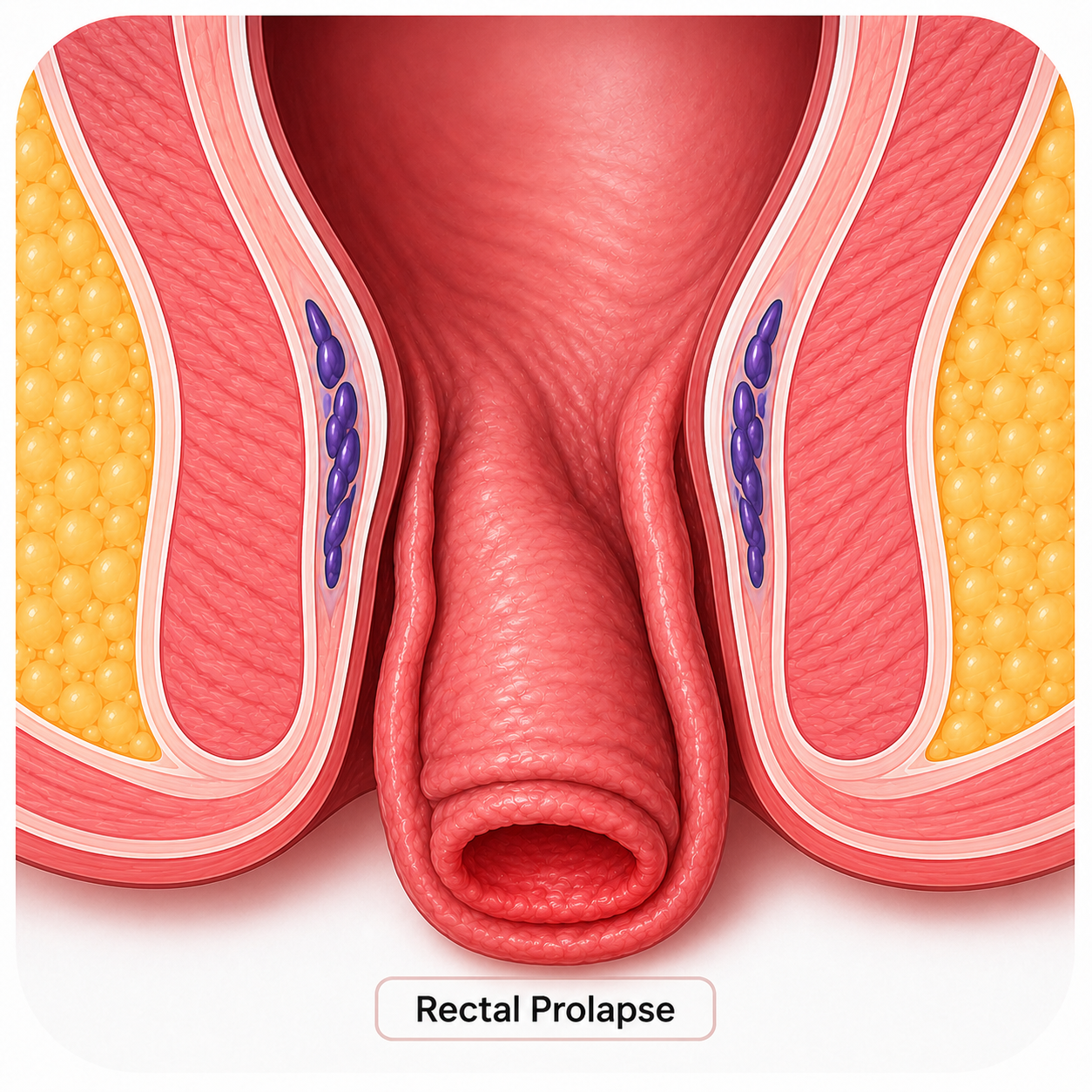
What is Rectal Prolapse?
Rectal Prolapse occurs when the rectum (the last part of the large intestine) detaches from its inside attachments and turns inside out, protruding through the anus. It is a highly distressing, painful, and embarrassing condition that severely impacts a patient's quality of life.
It is often mistaken for severe piles, but it is actually a distinct structural issue involving laxity of pelvic floor muscles and ligaments. If left untreated, it leads to chronic fecal incontinence, tissue ulceration, and in severe cases, gangrene due to restricted blood supply.
At Procto Surgical Hospital, we offer world-class laparoscopic and perineal reconstructive procedures (such as Laparoscopic Ventral Mesh Rectopexy) to secure the rectum back into its anatomical position, restoring normal bowel control and overall physical comfort.
At Procto Surgical Hospital Ahmedabad, Gujarat, we use advanced, US-FDA approved LHP/Laser technology to treat Rectal Prolapse without any cuts, bleeding, or pain.
Symptoms of Rectal Prolapse
Protruding Mass
A reddish, fleshy cylinder-like mass sticking out of the anus, initially only after bowel movements, but eventually during standing or walking.
Fecal Incontinence
Loss of control over gas and solid/liquid stools due to the chronic stretching of the anal sphincter by the prolapsed rectum.
Bleeding & Mucus
Constant leakage of mucus and blood from the exposed rectal mucosa, leading to soreness, itching, and underwear soilage.
What Causes Rectal Prolapse?
Chronic Constipation & Straining
Years of straining to pass hard stools stretches and weakens the suspensory ligaments of the rectum.
Pelvic Muscle Weakness
Weakening of the pelvic floor muscles, frequently caused by multiple vaginal deliveries, aging, or hysterectomy.
child birth trauma
Difficult or traumatic vaginal deliveries can damage the pelvic floor muscles and nerves, leading to rectal prolapse
Neurological Conditions
Spinal cord injury, back trauma, or multiple sclerosis that disrupts the nerve signals to pelvic sphincter muscles.
Chronic Coughing
Conditions like COPD or asthma that cause repetitive, sudden increases in intra-abdominal pressure.
Malnutrition or Malabsorption
Loss of support fat in the pelvis due to rapid weight loss or severe metabolic conditions.
Severity Stages of Rectal Prolapse
Early intervention prevents severe complications. Learn how this condition progresses.
Internal Prolapse
The rectum slides inside itself (intussusception) but remains entirely inside the anal canal. Difficult to diagnose without defecography.
Mucosal Prolapse
Only the inner lining (mucosa) of the rectum slips through the anus, appearing as folds of red tissue. Often mistaken for severe piles.
Complete Prolapse
The entire thickness of the rectal wall protrudes outside the anus. Concentric rings of mucosa are clearly visible.
Strangulated Prolapse
The protruded rectum is trapped by the sphincter, blocking blood supply. Tissue turns blue/black. Surgical emergency.
Open Surgery vs Laparoscopic Surgery vs Stapler Surgery
| Feature | Open Surgery | Laparoscopic Surgery | Stapler Surgery (Perineal) |
|---|---|---|---|
| Surgical Approach | Large abdominal incision (12-15 cm) | 3 tiny keyholes (5mm to 10mm) | Transanal / Perineal route |
| Hospital Stay | 6 to 8 days of painful hospitalization | 2 to 3 days (Fast recovery & discharge) | 1 to 2 days of minimal stay |
| Post-op Pain | Severe pain (Requires epidural / IV drugs) | Minimal (Managed with mild oral pills) | Very low (Performed in painless internal zone) |
| Sphincter Recovery | Slower, high impact on tissues | Excellent restoration of bowel control | Good restoration, very safe for elderly |
| Recurrence Rate | 5% to 7% recurrence | Extremely Low (<2% recurrence) | Less than 5% recurrence rate |
Why Choose Procto Surgical Hospital?
Recovery Timeline
Day 1: Procedure
Walk back home the same evening.
Day 2: Normal Activity
Resume normal light desk work.
Day 10: Near Zero Pain
Back to your full fitness routine.
Diet & Lifestyle Guidelines
Small changes in your daily routine can prevent recurrence and support fast healing.
Recommended Diet & Tips
Follow a strict high-fiber diet to avoid any straining or pushing in the toilet.
Drink 3-4 liters of water and consume daily stool softeners as prescribed by the doctor.
Avoid lifting heavy bags, heavy exercise, or pushing cars that raises belly pressure.
Support your pelvic area when coughing or sneezing by placing a hand or pillow over the lower belly.
Once fully healed, practice pelvic floor exercises (Kegel exercises) to build muscular support.
If rectal tissue protrudes, gently try to reduce it with a warm, moist towel while laying flat (consult doctor first).