
Best Pilonidal Sinus Doctor
in Ahmedabad, Gujarat
Painless, safe, and permanent laser solutions by Dr. Saurabh Patel. Get back to your normal life within 24 hours.
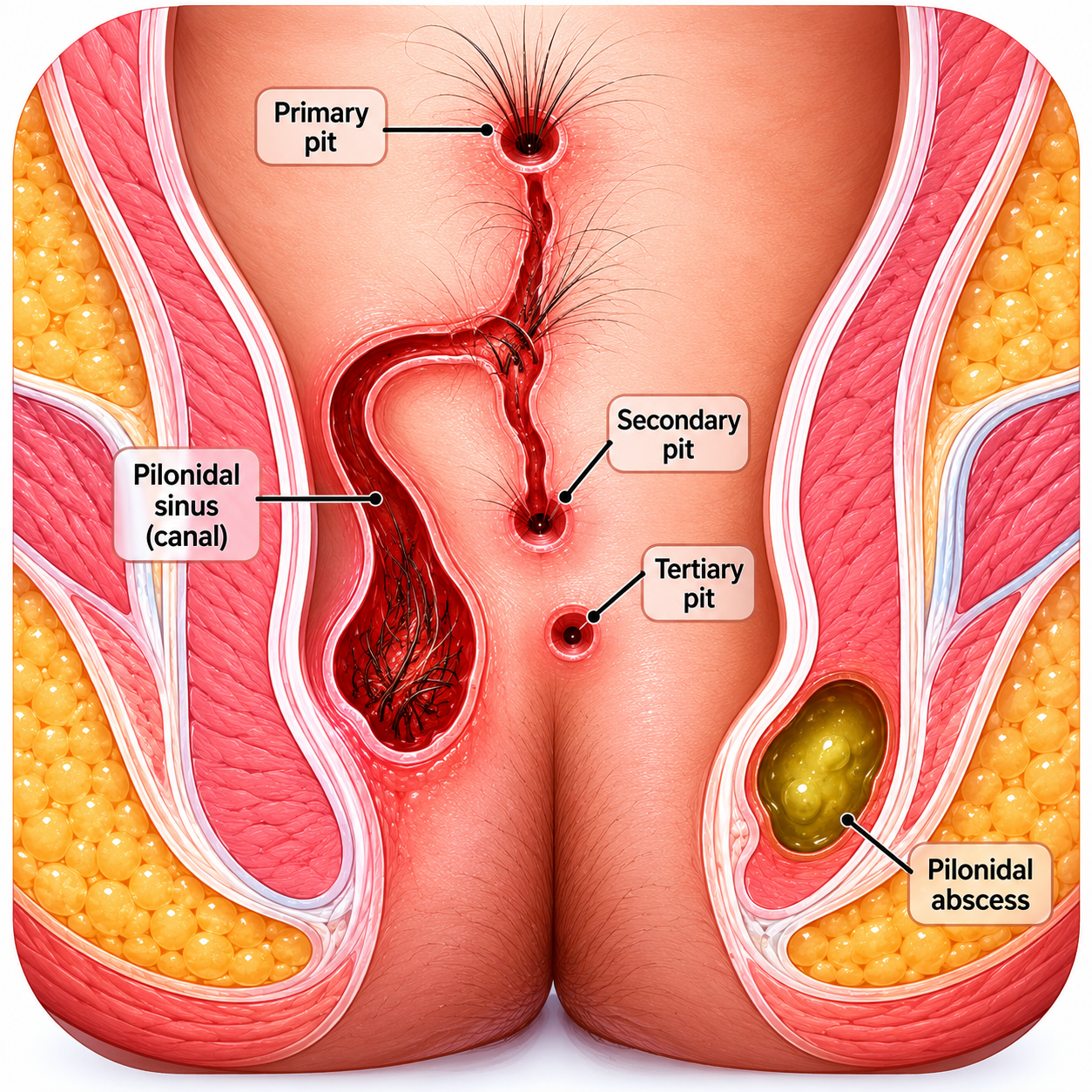
What is Pilonidal Sinus?
A Pilonidal Sinus (PNS) is a small hole or tunnel in the skin at the top of the buttocks cleft (near the tailbone). It usually contains hair, dirt, and debris, which leads to severe infection and abscess formation.
It is extremely common in young adults, people who sit for prolonged periods (like IT professionals, drivers), or individuals with coarse body hair. Traditional surgeries for this condition leave massive open wounds requiring months of daily dressings. At Procto Surgical Hospital, we offer advanced minimally invasive laser ablation and EPSiT (Endoscopic Pilonidal Sinus Treatment) to cure the sinus without leaving large scars or painful open wounds.
At Procto Surgical Hospital Ahmedabad, Gujarat, we use advanced, US-FDA approved LHP/Laser technology to treat Pilonidal Sinus without any cuts, bleeding, or pain.
Symptoms of Pilonidal Sinus
Pain & Swelling
A painful, red, swollen mass at the bottom of your tailbone that makes sitting, laying down, or walking extremely difficult.
Pus Discharge
Foul-smelling pus or bloody fluid leaking from the sinus opening, causing soilage and constant discomfort.
Visible Holes
One or multiple small pits (holes) visible in the buttock crease, which act as entry points for falling hair.
What Causes Pilonidal Sinus?
Burrowing Loose Hairs
Coarse loose hairs from the back or buttocks fall into the cleft, and friction forces them to puncture the skin.
Continuous Sitting & Friction
Sitting for long hours creates friction and heat in the natal cleft, pushing hairs deeper into the follicles.
Deep Natal Cleft
An anatomically deep buttock crease creates a vacuum-like effect, trapping sweat, moisture, and hair debris easily.
Body Hair
Body hair can become trapped in the natal cleft, acting as a foreign body that initiates infection.
Sedentary Lifestyle & Obesity
Lack of movement combined with excess pressure and sweating in the tailbone region increases abscess risk.
Poor Hygiene
Inadequate hygiene practices in the anal region can contribute to the accumulation of hair, sweat, and debris, increasing the risk of developing pilonidal sinus.
Severity Stages of Pilonidal Sinus
Early intervention prevents severe complications. Learn how this condition progresses.
Asymptomatic Pit
One or more tiny, painless pits visible in the tailbone cleft. No infection is present yet, but hairs are beginning to gather.
Acute Abscess
Bacteria and trapped hair cause a severe, sudden infection. A very painful, red, hot boil forms that requires immediate drainage.
Chronic Sinus
A persistent, long-standing tunnel that constantly leaks clear, bloody, or purulent fluid. Flares up periodically.
Complex Branching
Neglected sinus develops multiple interconnected tunnels (secondary tracts) opening onto different areas of the buttocks.
Laser vs. Traditional Surgery for Pilonidal Sinus
| Feature | Advanced Laser Treatment | Traditional Surgery |
|---|---|---|
| Wound Size & Stitches | EPSiT/Laser (Tiny 5mm entry, 0 stitches) | Massive 8-10cm open excision wound |
| Daily Wound Packing | Absolutely NOT required | Agonizing daily gauze packing for 2 to 3 months |
| Sitting capability | Sit comfortably from the next day | Sitting prohibited for 3 to 4 weeks |
| Work Resumption | Back to desk job in 3 days | Requires 3 to 5 weeks off from work |
| Scarring | Almost invisible dot-like scar | Large, disfiguring, deep valley-like scar |
| Recurrence Rate | Very Low (<1% with proper hygiene) | High recurrence (15% to 20%) |
Why Choose Procto Surgical Hospital?
Recovery Timeline
Day 1: Procedure
Walk back home the same evening.
Day 2: Normal Activity
Resume normal light desk work.
Day 10: Near Zero Pain
Back to your full fitness routine.
Diet & Lifestyle Guidelines
Small changes in your daily routine can prevent recurrence and support fast healing.
Recommended Diet & Tips
Keep the tailbone cleft completely hair-free using shaving or professional laser hair reduction.
Wash the natal cleft daily with a mild antibacterial soap and pat it perfectly dry.
Avoid sitting continuously for more than 45 minutes; stand up and walk around.
Eat a balanced, fiber-rich diet with leafy greens to promote tissue recovery.
Avoid wearing extremely tight clothing or synthetic underwear that traps moisture.
Apply a small amount of non-scented powder to the cleft if you sweat heavily.